
The skilled trades labor gap isn't a field problem. It's a back-office problem.

Updated: Aug 17
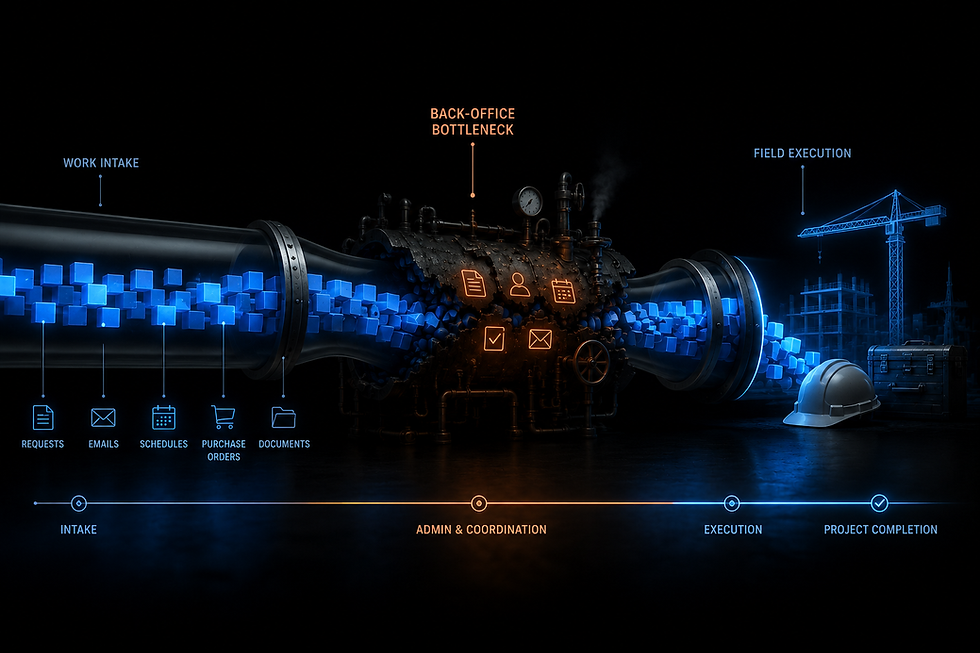
The skilled trades labor shortage gets discussed as a field staffing problem. For a lot of companies, the bigger bottleneck is actually happening behind the scenes.
The skilled trades labor shortage gets a lot of coverage, almost all of it focused on the same issue: not enough electricians, plumbers, HVAC technicians, and general contractors entering the field relative to demand. That's a real and well-documented problem.
But for a lot of construction and home services companies, the more immediate constraint on growth isn't how many crews they can field. It's how much administrative load each crew is dragging behind them.
What's actually slowing companies down

Permit tracking and documentation
Deadlines and jurisdiction-specific paperwork mean a missed step can stall a project for weeks and it's exactly the task that falls through the cracks when whoever owns it is also running a crew.

Vendor and supplier coordination
Confirming orders and chasing delivery timelines is high - volume work. Handled inconsistently, the cost shows up as crews standing around waiting on materials.

Scheduling and dispatch
A reactive scheduling system means more windshield time, more rescheduling, and more frustrated customers, none of which relates to technician skill.

Customer communication after quotes
A contractor who's great at the work but slow on follow-up loses jobs to a faster competitor, regardless of who'd actually do better work.
Why this gets misdiagnosed as a labor problem
When a company feels like it can't grow, the instinct is to look at field capacity. Do we need another crew. Can we hire another technician? That often misses where the real constraint is sitting.
"More crews just means more permits to track, more vendors to coordinate, and more quotes to follow up on all funneling through the same bottleneck that was already strained."
This is why some companies grow steadily while others with similar field capacity are stuck. The difference often isn't how many technicians a company can find — it's how efficiently the work those technicians generate gets supported behind the scenes.
Where to draw the line

Well suited to outsource
Permit tracking & follow-up
Vendor coordination
Quote follow-up
Dispatch & scheduling support

Stays in house
Licensed field expertise
Complex/unusual job pricing
Major commercial client relationships
The actual opportunity here
Companies that separate the field constraint from the back office constraint tend to find more growth capacity than they expected, without needing to solve the labor shortage problem first.
The technicians a company already has can generate more revenue when the administrative load around their work is handled efficiently. That's a lever many construction and home services companies haven't fully pulled yet mostly because the back office bottleneck doesn't get discussed nearly as often as the field staffing one.


Comments